
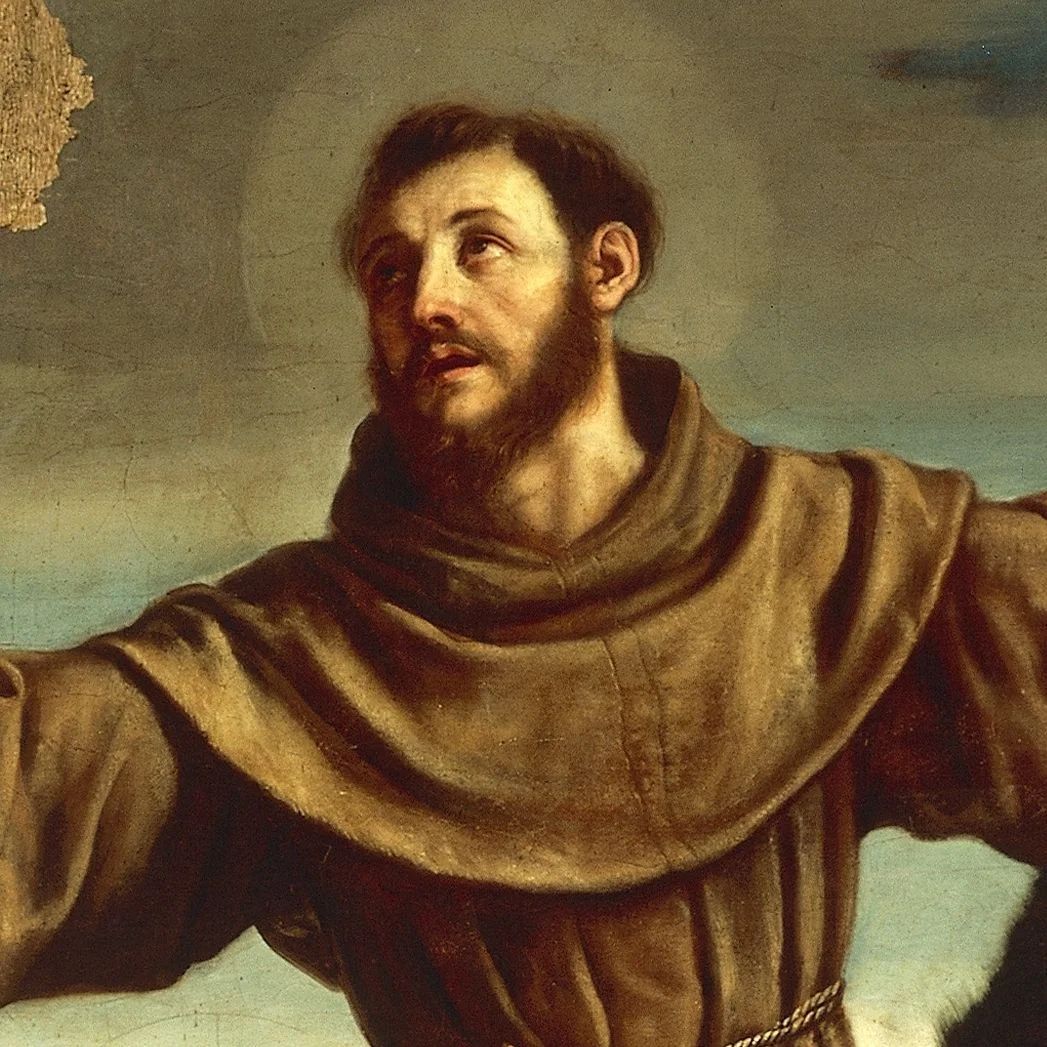
Saint Francis of Assisi, Founder of the Friars Minor, Confessor, 1181-1226, Feast: October 4
St. Francis of Assisi (c. 1181/1182 – October 3, 1226) is one of the most beloved and influential saints in Christian history. He founded the Franciscan Order, embraced radical poverty, and showed deep love for creation, the poor, and peace. 2026 marks a special Jubilee Year of St. Francis (January 10, 2026 – January 10, 2027), proclaimed by Pope Leo XIV to commemorate the 800th anniversary of his death (the Transitus).
During this 2026 Jubilee Year, the Church encourages pilgrimage to Franciscan sites (especially in Assisi), reflection on his example of holiness, peace, and mercy, and obtaining a plenary indulgence under usual conditions.
Early Life
Francis was born Giovanni di Pietro di Bernardone in Assisi, Italy (in the Duchy of Spoleto), around 1181 or 1182. His father, Pietro di Bernardone, was a prosperous cloth merchant, and his mother, Pica (possibly of French or Provençal origin), came from a noble background. His father was away in France at the time of his birth, so his mother had him baptized Giovanni (John); upon returning, Pietro renamed him Francesco ("Frenchman") due to his love of French culture.
Francis grew up in comfort and luxury. He received some education (learning Latin and French), enjoyed the troubadour culture of poetry and song, and became a lively leader among Assisi’s young men—known for partying, fine clothes, and worldly ambitions. He dreamed of knighthood and military glory.
Conversion and Turning Point
In 1202, Francis joined a war between Assisi and Perugia. He was captured and imprisoned for about a year, which began to sober him. After release and a period of illness, he tried again to pursue a knightly life but had a pivotal dream or vision that redirected him home.
A key moment came when he encountered a leper. Previously repulsed by such sights, he now felt compelled to embrace and kiss the man—symbolizing his shift from worldly values to Christ-like compassion. While praying in the dilapidated chapel of San Damiano, he heard Christ say, “Francis, repair my church.” He initially took this literally, selling cloth from his father’s shop to repair the building, which led to conflict with his father.
In a dramatic public scene, Francis renounced his inheritance before the bishop and his father, stripping off his fine clothes and embracing a life of poverty. He began living as a beggar, preaching repentance, and repairing chapels by hand.
Francis’s health declined due to asceticism, eye disease (trachoma), and other ailments. He died peacefully on October 3, 1226, at age ~44–45, singing psalms and welcoming “Sister Bodily Death.” He was canonized just two years later by Pope Gregory IX on July 16, 1228. His feast day is October 4. He is a patron saint of Italy, animals, merchants, and ecology.
Major Events and Legacy
Founder of the Franciscan Orders
- Francis founded the Order of Friars Minor (Franciscans) around 1209, emphasizing poverty, humility, preaching the Gospel, and service to the poor and sick. He and his “lesser brothers” (fratres minores) traveled, worked manual labor or begged, and cared for the sick and outcasts. Pope Innocent III approved the order orally around 1210, and it grew rapidly. His approach stressed joy, simplicity, and following Christ’s example literally—without possessions, embracing evangelical poverty. The Franciscan family became one of the largest and most influential religious orders in the world, focusing on active ministry, education, missionary work, and social justice. Franciscan communities and spirituality remain vibrant globally nearly 800 years later.
- He co-founded the Poor Clares in 1212 (with St. Clare of Assisi) for women and the Third Order (laypeople who could live Franciscan ideals without leaving their families or jobs).
Stigmata
- St. Francis of Assisi and the Stigmata is one of the most famous and significant events in his life, marking him as the first recorded person in Christian history to receive the stigmata; the visible wounds of Christ’s crucifixion. In the summer of 1224, two years before his death, Francis withdrew to Mount La Verna (in the Apennines of Tuscany, Italy) for a 40-day period of intense prayer and fasting in preparation for the Feast of St. Michael the Archangel (September 29) and in honor of the Exaltation of the Holy Cross. While praying on the mountain (traditionally dated to September 17, 1224, or around the feast of the Exaltation of the Cross on September 14), he had a profound vision:
- A seraph (a six-winged fiery angel) appeared to him, descending from heaven.
- Between the wings of the seraph was the figure of a crucified man (Christ).
- Francis experienced a mixture of great joy (at the loving gaze of Christ) and deep sorrow (at the sight of Christ’s suffering).
As the vision ended, the marks of the crucifixion were miraculously imprinted on Francis’s own body. These were not superficial wounds but physical signs that matched descriptions from early sources. According to eyewitness and near-contemporary accounts (especially St. Bonaventure and Brother Leo, Francis’s close companion):
- Hands and feet: Marks resembling nails pierced through them. The heads of the nails appeared on the palms/wrists and the upper parts of the feet; the points protruded on the opposite sides, with bent nail-like flesh.
- Right side: A large wound as if pierced by a lance (like Christ’s side), which often bled, soaking his clothing.
- The wounds were painful and continued to bleed at times for the remaining two years of his life.
After his death in 1226, his body was examined, and the wounds were visible, with Brother Elias announcing them publicly to the Franciscan Order. The event is commemorated annually on September 17 (the Feast of the Stigmata of St. Francis).
Love for Creation
- He is famous for preaching to birds, taming a wolf (in the legend of Gubbio), and writing the Canticle of the Creatures (or Canticle of the Sun), praising God through Brother Sun, Sister Moon, and all elements of nature. This led to his designation as patron saint of ecology by Pope John Paul II in 1979. His example has influenced modern environmental thought, including Pope Francis’s 2015 encyclical Laudato si’, which draws directly from Francis’s vision of caring for our common home. Animal blessing ceremonies on his feast day (October 4) are now widespread, and he is the patron of animals.
Promoter of Peace, Dialogue, and Compassion
- Francis emphasized peace, reconciliation, and love for all people. He cared for lepers (overcoming his own disgust) and preached to the poor. He promoted peace, famously crossing enemy lines during the Fifth Crusade to meet Sultan al-Kamil in Egypt (1219), seeking dialogue rather than conflict.
St. Francis’s Living Nativity in Greccio (1223)
- St. Francis of Assisi is widely credited with creating the first living Nativity scene (known as a presepe or crèche) in 1223 in Greccio, Italy. In the weeks before Christmas 1223, Francis asked a friend, Giovanni Velita, to prepare a cave near Greccio with a manger (feeding trough) filled with hay, along with a live ox and donkey. On Christmas Eve, he celebrated Midnight Mass there in the presence of the local people and friars. The scene vividly recreated the humble circumstances of Jesus’ birth in Bethlehem, making the mystery of the Incarnation tangible for ordinary people.
According to St. Bonaventure’s biography of Francis (written around 1260), Francis wanted people “to see with bodily eyes the inconveniences of his infancy, how he lay in the manger, and how the ox and ass stood by.” During the celebration, Francis preached about the humility and poverty of Christ, and tradition holds that the Christ Child appeared miraculously in the manger.
The event moved people deeply, and word spread quickly through the Franciscan Order. Francis wanted people to experience the humility and poverty of Christ’s birth, not just hear about it. This emphasis on tangible, heartfelt devotion is why Nativity scenes remain powerful today; they invite contemplation of the Incarnation. Pope Francis highlighted this in his 2019 apostolic letter Admirabile Signum, praising the crèche as a simple yet profound way to proclaim the Gospel. During the current Jubilee Year of St. Francis (2026), many places are highlighting this legacy alongside the Canticle of the Creatures and other aspects of his life.
The site in Greccio is still venerated today as the Sanctuary of Greccio, with the original cave chapel preserved. Every Christmas, Greccio stages a major living reenactment (now in its 50+ years as an annual event), attracting thousands of pilgrims.
Why He Matters Today
Francis’s radical simplicity, joy amid suffering, care for the marginalized, and harmony with creation continue to inspire millions across denominations and beyond Christianity. He challenged the Church of his time toward greater authenticity while remaining deeply loyal to it. His movement became one of the largest religious orders in the world.